Origin
Covering the head is not commanded in the Torah. The Talmud presents it as an expression of piety: the mother of Rabbi Nachman bar Yitzchak advised him to cover his head "so that the fear of Heaven may be upon you", and Rav Huna son of Rav Yehoshua is said never to have walked four cubits with his head uncovered.1,2
Meaning
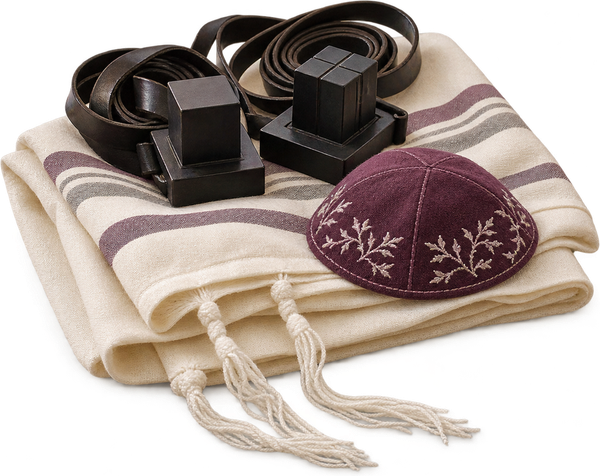
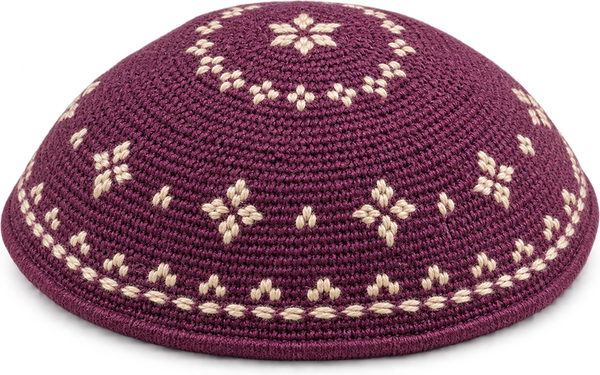
The kippah expresses an awareness that God is above us. For many it is also a visible sign of Jewish identity.
Use
The Shulchan Arukh rules that a man should not walk about bareheaded. In Orthodox practice men keep their heads covered at all times; during prayer and study it is a universal custom.3
In Conservative and Reform communities women also often wear a kippah during prayer; in Reform settings wearing one is voluntary.
Historical development
The form of the head covering has changed over history; the small cap in its present form spread in the modern era. The word yarmulke probably comes from Polish, though its origin is disputed.
Related traditions
The style of a kippah often indicates affiliation: a colorful crocheted kippah (kippah srugah) is associated with Religious Zionism, a black velvet one with Haredi and yeshiva circles. Haredi men also wear a hat.
Visitors to synagogues, including those in Prague, receive a paper kippah at the entrance; men are expected to cover their heads in the synagogue.
FAQ
Is the kippah commanded by the Torah?
No. It is an ancient custom that has acquired halakhic force in Orthodox practice.
Does a non-Jew have to wear a kippah in a synagogue?
Most synagogues require it of men as a sign of respect and lend out kippot.
Do women wear a kippah?
In Orthodoxy married women cover their hair with a scarf, a wig or a hat, not a kippah. In liberal movements women sometimes also wear a kippah.