Origin
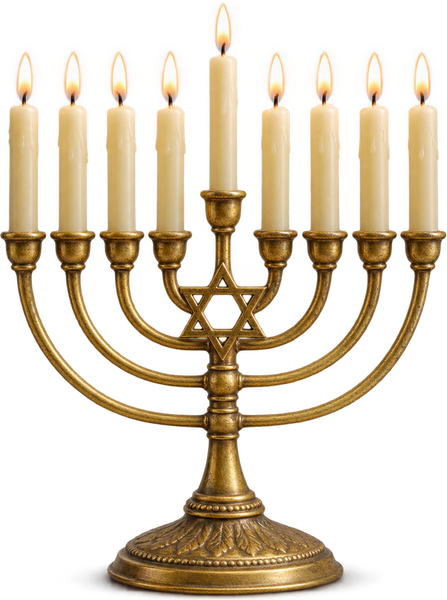
The Talmud gives the basic commandment: one light per household each evening; the more zealous light one for each member; the most zealous, following the School of Hillel, add one light each evening up to eight.1
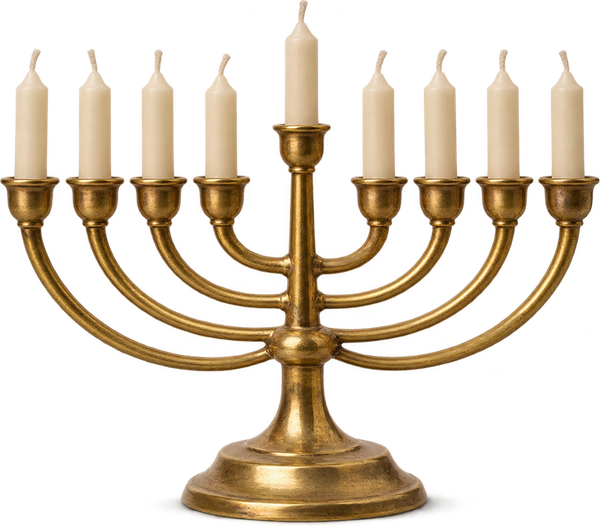
The name chanukiyah is Modern Hebrew; in Yiddish the lamp is called menoyre or khanike-lomp, and in English often "Hanukkah menorah".
Meaning
The lights recall the miracle that tradition links with the rededication of the Temple; the Talmud tells of oil that lasted eight days. The purpose is to "publicize the miracle" (pirsumei nisa).1
Use
The lights should stand in a single row at the same height; the helper light, the shamash, is set apart (higher or to the side). According to the Talmud the hanukkiah is placed at the entrance, on the outside or opposite the mezuzah, or else in a window facing the street.2,3
Candles are placed from right to left and lit from left to right, the newest first. Oil or candles may be used; according to the Shulchan Arukh olive oil is best.4
No use may be made of the Hanukkah lights (for example, for reading); this is why the shamash is added.4
Historical development
Oil lamps with eight wicks and a backplate (bench-type lamps), hung on the wall, have survived from the Middle Ages. Standing lamps resembling the menorah spread in Ashkenazi settings from the late Middle Ages.5
Related traditions
In Ashkenazi practice each member of the household lights their own hanukkiah; in Sephardi practice one person lights for the whole household.6
The collection of the Jewish Museum in Prague includes Hanukkah lamps from the Czech lands, many of them of pewter and silver.7
FAQ
How many branches does a hanukkiah have?
Eight for the Hanukkah lights and one for the shamash, nine in all.
Can I use an electric hanukkiah?
Most halakhic authorities do not consider it to fulfill the commandment; it serves rather as decoration. Liberal movements are more flexible.⁂ To verify
Where should the hanukkiah be placed?
Traditionally at the entrance or in a window, so that it can be seen from outside.
Sources
Primary sources
- 1Babylonian Talmud, Shabbat, 21b text ↗
- 2Babylonian Talmud, Shabbat, 21b–22a text ↗
- 3Shulchan Arukh, Orach Chayim, 671 text ↗
- 4Shulchan Arukh, Orach Chayim, 673:1 text ↗
- 6Shulchan Arukh, Orach Chayim, 671:2 – Karo a glosa Rema text ↗
- 8Babylonian Talmud, Shabbat, 21b–23a text ↗
- 9Shulchan Arukh, Orach Chayim, 670–684 text ↗