Origin
Meaning
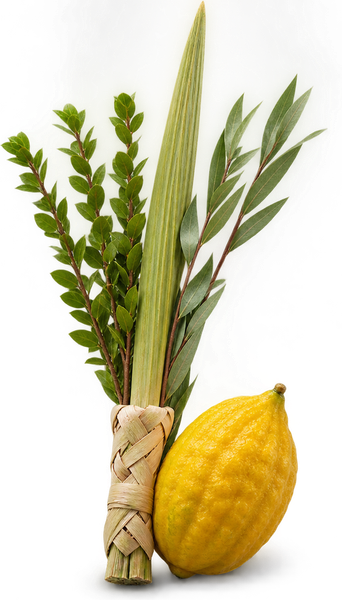
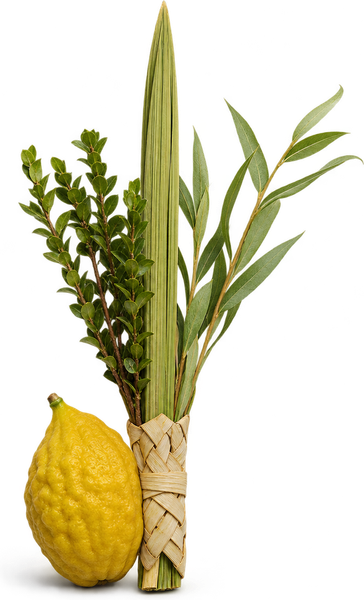
The midrash compares the four species to four types of people according to whether they have "taste" (Torah) and "fragrance" (good deeds); all are bound together.4
Use
The lulav, two willow branches and three myrtle branches are bound together. The blessing al netilat lulav is recited with the etrog in the other hand; then the bundle is shaken in six directions (na'anuim).5,6
Historical development
The lulav and etrog are among the frequent motifs of ancient Jewish art: on coins of the Bar Kokhba revolt, on synagogue mosaics and on tombstones.11
Related traditions
During the hoshanot the bimah is circled with the lulav; on Hoshana Rabbah seven times, and a bundle of willow branches (aravot) is beaten.12
Etrogim are bought with great care; they are kept in decorated cases (etrogim), some of which are in the collections of the Jewish Museum in Prague.13
According to folk custom, women who wish to conceive, or pregnant women, bite off the pitam of the etrog after Sukkot or make preserves from the etrog.
FAQ
Why is the lulav shaken in all directions?
Traditional interpretation sees in it an acknowledgment of God's rule over all directions of the world, over heaven and earth.
What is done with the etrog after the festival?
It is often made into preserves or used as a fragrant plant for havdalah.
Is the lulav taken on Shabbat?
No. The rabbis forbade it so that no one would carry it through a public domain.⁂ To verify
Sources
Primary sources
- 1Leviticus, 23:40 text ↗
- 2Babylonian Talmud, Sukkah, 35a text ↗
- 3Babylonian Talmud, Sukkah, 32b text ↗
- 4Midrash Rabbah, Vajikra raba 30:12
- 5Mishnah Sukkah, 3:9 text ↗
- 6Shulchan Arukh, Orach Chayim, 651 text ↗
- 7Mishnah Sukkah, 3:1 text ↗
- 8Mishnah Sukkah, 3:6 text ↗
- 9Mishnah Sukkah, 3:12 text ↗
- 10Mishnah Sukkah, 4:2 text ↗
- 12Mishnah Sukkah, 4:5 text ↗
- 14Babylonian Talmud, Sukkah, 37b text ↗
- 15Babylonian Talmud, Sukkah, 42b–43a text ↗
- 16Mishnah Sukkah, 3 text ↗
- 17Shulchan Arukh, Orach Chayim, 645–658 text ↗